POL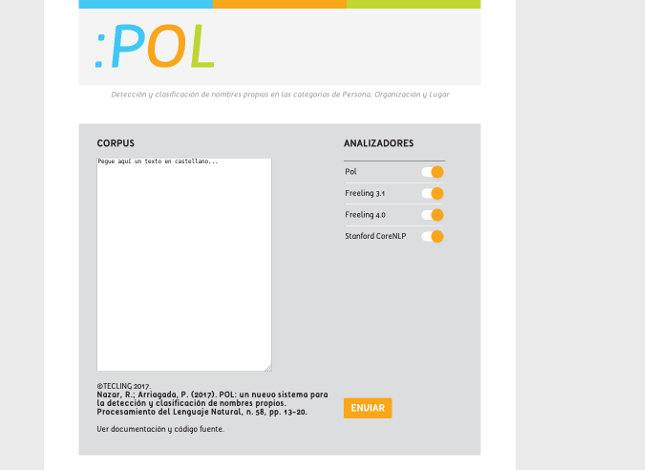
The purpose of this research is to develop a methodology for the detection
and categorisation of named entities or proper names (PPNN), in the categories of
geographical place, person and organisation. The hypothesis is that the context of
occurrence of the entity –a context window of n words before the target– as well as
the components of the PN itself may provide good estimators of the type of PN. To
that end, we developed a supervised categorisation algorithm, with a training phase
in which the system receives a corpus already annotated by another NERC system.
In the case of these experiments, such system was the open-source suite of language
analysers FreeLing, annotating the corpus of the Spanish Wikipedia. During this
training phase, the system learns to associate the category of entity with words of
the context as well as those from the PN itself. We evaluate results with the CONLL-
2002 and also with a corpus of geopolitics from the journal Le Monde Diplomatique
in its Spanish edition, and compare the results with some well-known NERC systems
for Spanish.
Announcement (October 9, 2026)This software is already deprecated because there is now another one (Wikacho) that fulfills the same purpose with better performance. We only leave it here for documentation purposes.Web demo: https://www.tecling.com/pol Source code: https://www.tecling.com/pol/source/sourcePol.zip It contains:
To train POL for making a new model, you need to have Perl's Storable module installed.
These models were created
with a x86_64 HP Proliant machine with GenuineIntel CPU 1064.000 MHz running Linux (Ubuntu 14.04). If you have a different kind of machine (e.g., a Desktop pc on Windows), then you will probably need to create the models again by using poltrain.pl.
|
 FREE PALESTINE!
ABOUT
RESEARCH
SOLUTIONS
SOFTWARE
FREE PALESTINE!
ABOUT
RESEARCH
SOLUTIONS
SOFTWARE
|
Technologies for Linguistic Analysis |
||